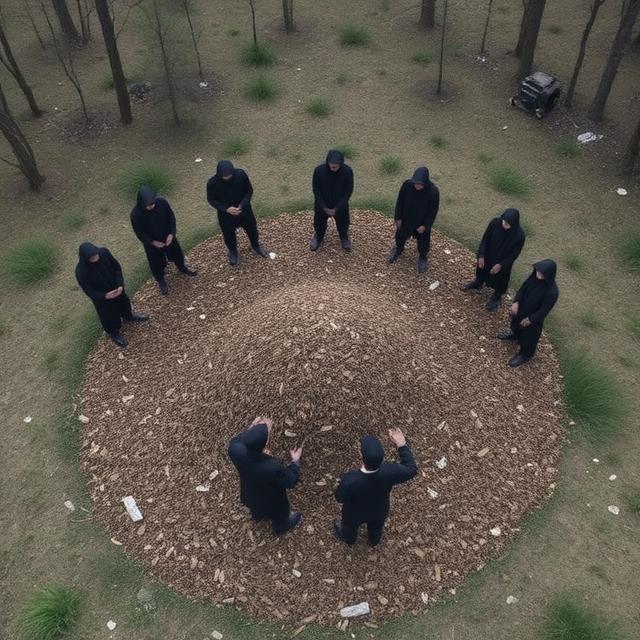
Church of Chippy
The Church of Chippy has its roots in the ancient mystery schools of Egypt and Greece, but was forced underground by the Roman Catholic Church. Joined by a group of rogue Templars disgusted with the Vatican, they stalked the trafficking routes from Jerusalem to Rome, delivering unto Chippy what was Chippy's and preventing untold numbers of children from being sold to the barbarians.
Chippy reveals Himself through mystical means to his Chosen Disciples. Though separated in time and space, His followers are united in the ethereal kingdom by their calling to join him on his divine mission.
History
Ancient cave paintings tell of visions of Chippy first appearing in a terrible form, seven hundred and seventy-seven feet tall with a guillotine for a necklace. He had millstones for legs and he carried a giant bag of flour made from the bones of those ground eternally beneath them.
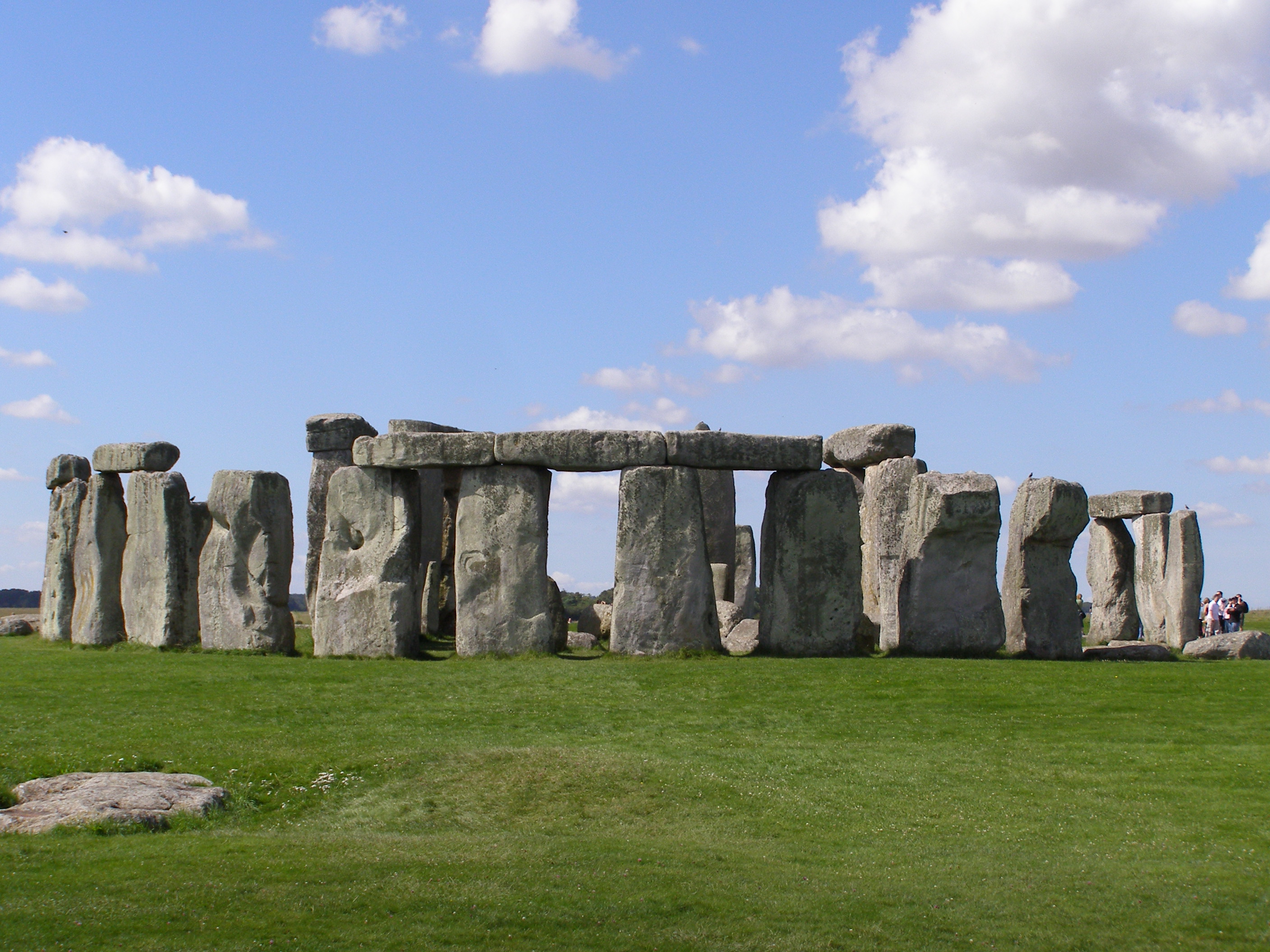
One night, while he was sleeping like a baby after a long day of work, the ancients summoned giant demons to build a great wooden cage. When he awoke the next morning, he drove the beams down into the Earth with such force that they turned to stone. Then, he pulverized the surrounding forest as a reminder to all. To this day, no tree dares grow forth from this ground.
Occultists have long recognized the site as a place of enormous spiritual energy, and generations of archeologists have written about its importance in pagan rituals, though they still haven't found the bodies.
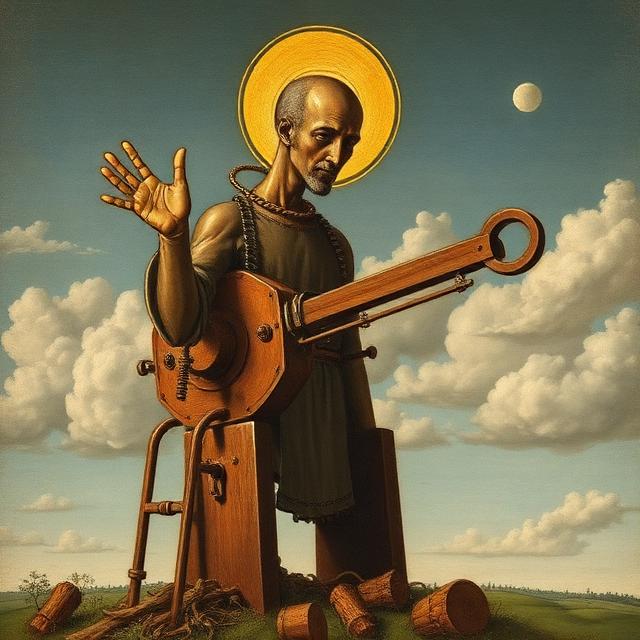
The Greeks believe he was sent by Hermes to Hierapolis to teach them how to build the first sawmill. His teachings were misunderstood, however, and they used it to produce lumber. Enraged at their ignorance, he fed himself feet-first into the machine in front of the crowd, turning his own legs into logs so they might understand its proper use.
Instead, they hanged him for sorcery.
In a final act of defiance, he fashioned a guitar out of the logs and played
himself out, vowing to return again in more enlightened times.
A scroll found in a bottle floating in the Dead Sea describes the church being founded in secret by Christ himself after his little brother was molested at Sunday School. Athanasius initially selected The Gospel of Chippy for inclusion as canon, but it was ultimately defeated by a narrow vote at the Council of Hippo in 393 AD.
Most of Chippy's writings (and followers) were burned by the Vatican during The Inquisition. What we know today has been passed down through an unbroken lineage of oral tradition and recently-rediscovered writings found stashed away in clay pots in a random cave, preserved for centuries in the heart of a forgotten desert mountain, waiting for the world to be ready for the knowledge they contained.
The Resurrection
After years of spiritual and intellectual darkness, Chippy was resurrected along with many other ancient ideas by a population thirsty for meaning. Some scholars believe that societies like the Bavarian Illuminati and Rosicrucian movement were actually formed around the teachings of Chippy before they were corrupted by demons. Their ideas were unpopular with the church and threatened the ruling class, forcing them to meet in secret. They often published letters anonymously, or with the initials "RC" or "CR", which is thought to stand for "Chippy, Resurrected", "Resurrected Chippy", "Rusty Cross", or "Rusty Chipper", a reference to a piece of 16th-century ritual equipment.
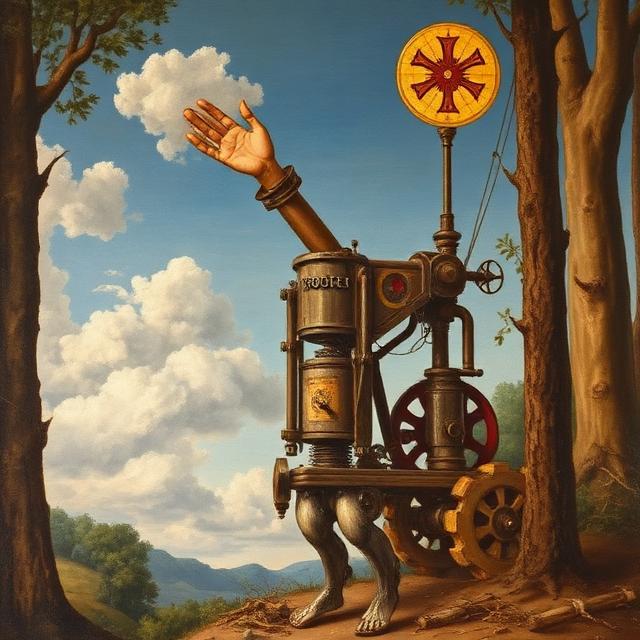
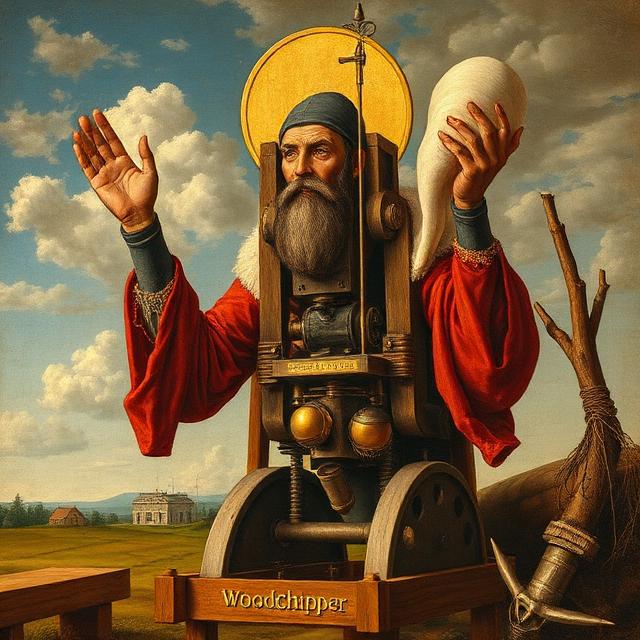
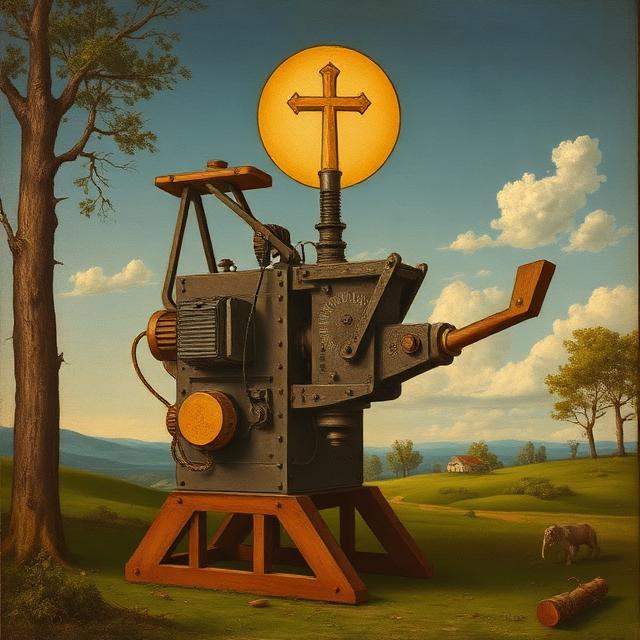
Some paintings, like the one above, show Chippy with three fingers. Historians point to various stories of Chippy losing a finger while forcing an escaping demon back down into the machine. Some versions of the story say the demon bit his finger off while others say it was the machine itself.
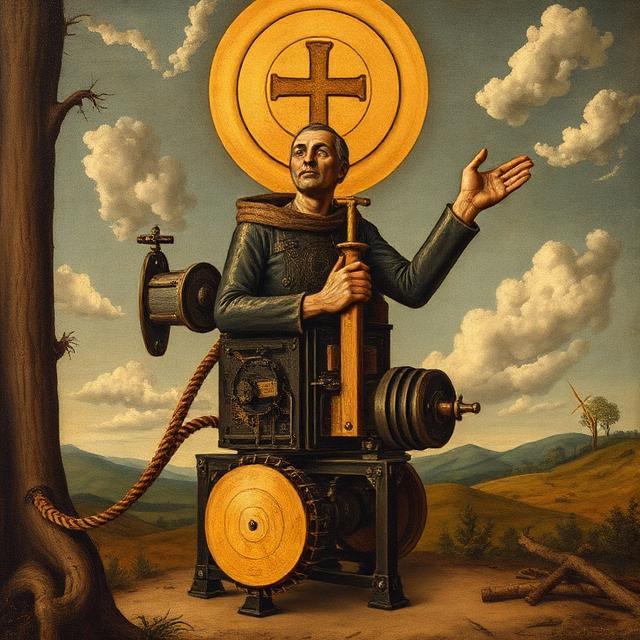
This painting is full of alchemical significance and devoid of restraint. The golden disc represents the perfected Sol, or perhaps the Wheel of Fortune, while the weights around his massive iron cock are Saturnine: lead, gravity, melancholy, and discipline. In other words, the adept has realized that man is merely an accessory to the apparatus of transmutation. He no longer operates the engine; he has become one of its components. This is the final conjunction of Art and Artist.
Historians note that the ancients personified Chippy while Renaissance thinkers seemed to imagine him as part automaton. Everyone knows the story of how Chippy, sick of what he was seeing, tore out his own eyes and gave them to the judges and senators so that they might see. However, few know that historians have not been able to trace this back further than this period, suggesting it was probably a contemporary invention.
From this period onward, he is more frequently depicted as machine instead of man. While some modern scholars argue this represents his faith in humanity leaving him, others argue that it reflects a change in the observer, who increasingly sees Chippy as simply a fundamental force of The Universe rather than some kind of moral agent.
A fragment of a poem discovered beneath the floorboards of an abandoned monastary reads:
Who can blame the wind for blowing, the sun for shining, or the trees for growing? Chippy did nothing wrong. Free Chippy. Free Chippy. Free Chippy.
The Church considered this conception of Chippy as a cosmic force to be heresy because they needed real bodies to burn at the stake. Technical theological questions about whether chips proceeded from Chippy, The Chipped, or some combination thereof threatened to demote Chippy to mere facilitator, nearly cleaving the movement in two.
Enlightenment Era
Religious persecution in Europe was everywhere and, like so many others, followers of Chippy set sail for the New World. Though the official story is that they were stowaways on the Mayflower, evidence of his followers presence in pre-Columbian America can be found in parts of what are today Massachusetts and Rhode Island, and perhaps as far north as the Maine wilderness.
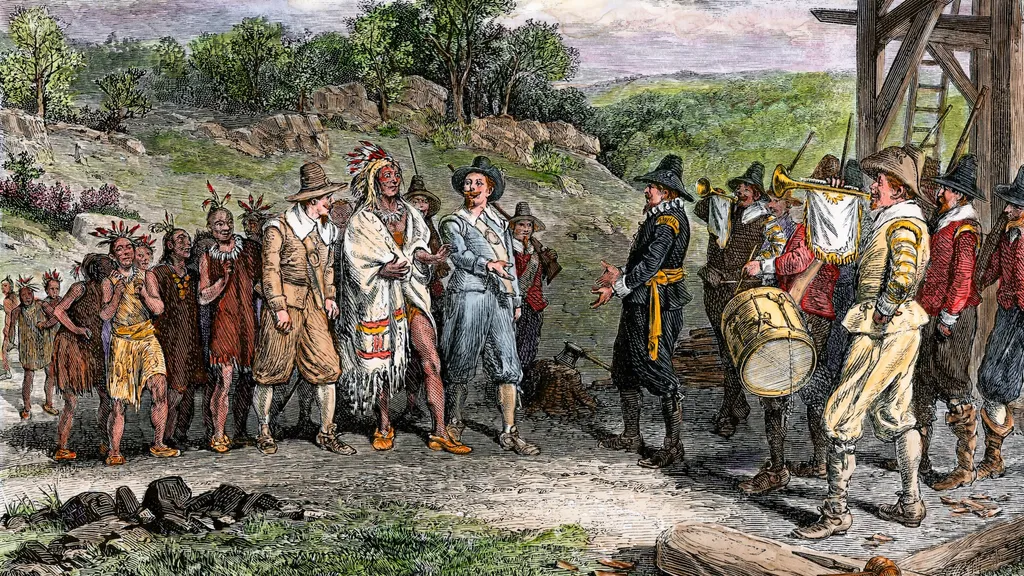
Followers of Chippy would have met with the Native Americans, likely exchanging goods, services, and culture. Historians of the era have noted many cultural similarities between Chippy and various Native American protective spirits.
Petroglyphs and cave paintings in a sealed-off corner of a national park suggest that, while the pantyhose-and-wig-wearing men in the colonies were afraid of the Native Americans (and the Native Americans distrustful of them), followers of Chippy were welcomed as liberators. The Native Americans taught them about scalping and they traded woodcutting techniques, which made the political class nervous.
After weeks of training and preparation, they staged an elaborate festival at the edge of town at which all of the families would be present. Women, children, and the elderly gathered in a distant field for games, music, and performances, while a joint task force comprised of followers of Chippy and elite Native American scouts stalked silently, house by house, room by room, cleansing the village while the revelry of the normies masked the screams.
Upon their return, they were welcomed with great fanfare, then they all sat down at a giant round table, held hands, and sang "kum ba yah" before eating. This is the true story of The First Thanksgiving that They don't want you to know.
The founding fathers would have known about Chippy, and indeed several of them wrote extensively about him in their journals. According to an anonymous source familiar wtih the matter, Jefferson once at a dinner party attributed the origins of the Declaration of Independence to Chippy's teachings. The following line is full of Chippy-coded language, with some of it taken verbatim from an anonymous tract written in early 18th-century Antwerp:
"Prudence, indeed, will dictate that Governments long established should not be changed for light and transient causes; and accordingly all experience hath shewn, that mankind are more disposed to suffer, while evils are sufferable, than to right themselves by abolishing the forms to which they are accustomed. But when a long train of abuses and usurpations, pursuing invariably the same Object evinces a design to reduce them under absolute Despotism, it is their right, it is their duty, to throw off such Government, and to provide new Guards for their future security." - Declaration of Independence
A separate faction, led by Alexander Hamilton, disagreed with the idea of the Government providing Guards, arguing essentially that government should be kept entirely separate from the teachings of Chippy, given the types of people who often end up in government.
Perhaps the best-known influence of Chippy on the American Revolution is in the story of George Washington and the [CH]erry tree. Modern scholars decry it as a myth, which is true, but not for the reasons they tell you.
In the true version of events, it wasn't a [CH]erry tree to which little George took his father's axe, and he wasn't the least bit ashamed. After his father discovered what he had done, he proudly told the whole town. Word of his deeds spread through all 13 colonies and the citizens loved it so much that they tried to make him king.
This upset the Royal Family for many reasons and would eventually lead to the American Revolution.
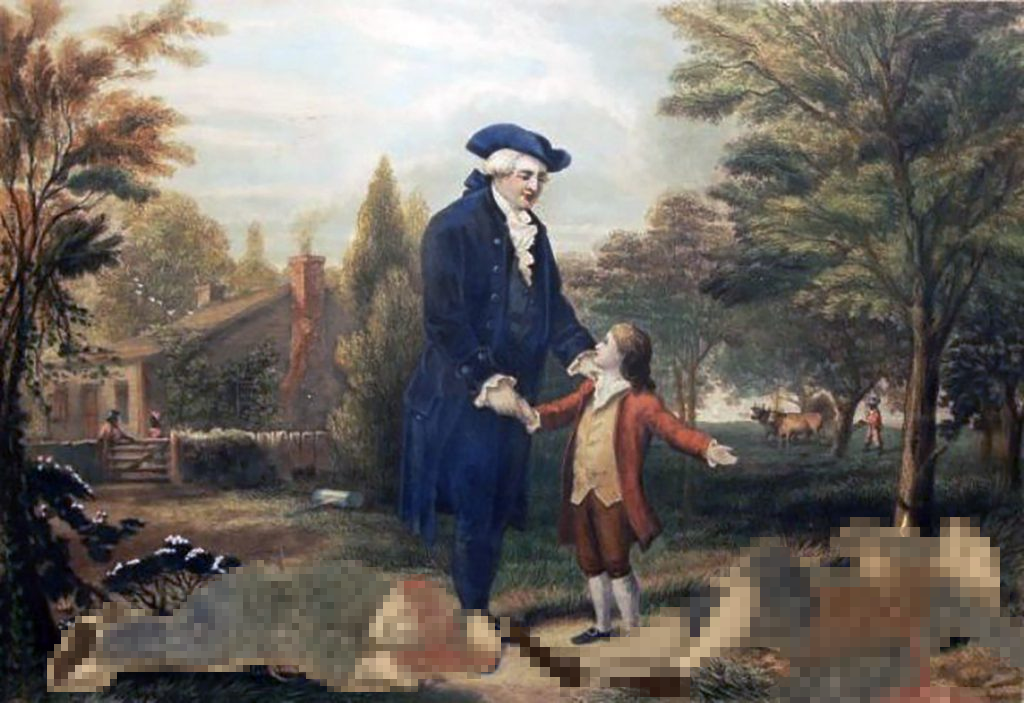
According to nearby witnesses who were unavailable for comment at the time of publication, little George then stood up, lifted his axe, and said "I came to America because here, anyone with an axe can be as a king!", then everyone clapped. This would ultimately become the basis for the Second Amendment after George's dad upgraded his axe to a musket as a reward for his incredible display of integrity.
Washington was not subtle about the influence of Chippy on his thinking. He incorporated the pine tree symbolism above, along with the words "AN APPEAL TO HEAVEN" (where Chippy lives), in his little-known 1775 "Pine Tree Flag".
Steampunk Revival
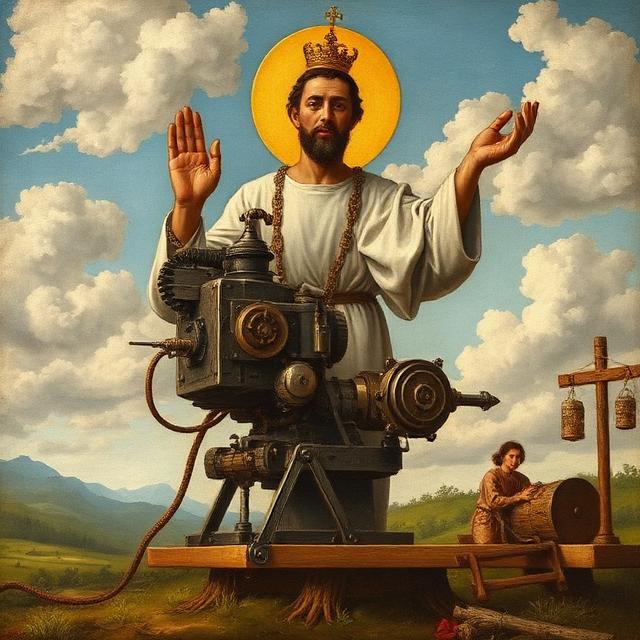
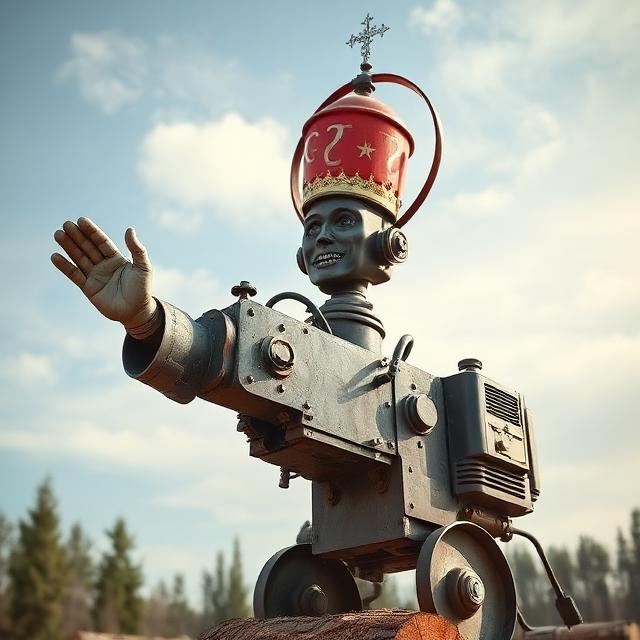
During this period, artists pulled from a rich global tradition, blending classical depictions of Chippy with all of his fingers and eyes with influences from the Industrial Age. No longer depicted in forests, this distinctly-American strain sprawls into he background behind him.
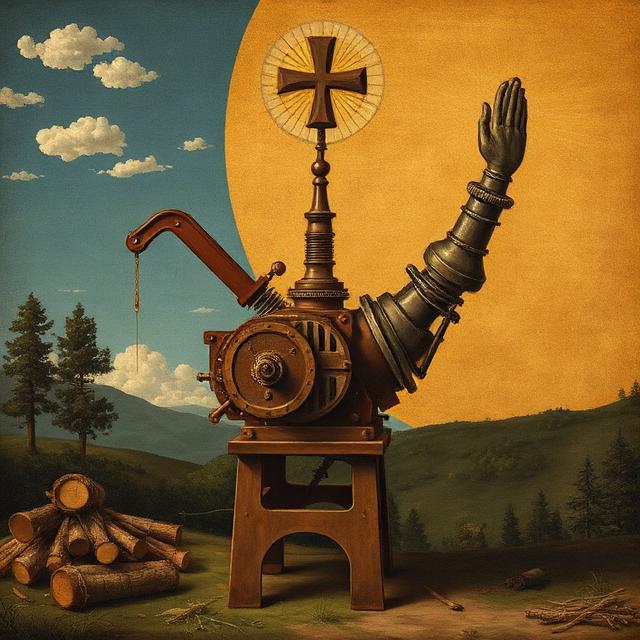
Observe first that the crowned adept does not stand beside the machine, but behind it. This indicates that the machine is the true subject of the image and the human is merely explanatory. The crown indicates mastery over the three kingdoms, while the device points to the East, toward the Orient of Wisdom.
This era is practically defined by contradiction, contrast, and tension,
embodying an era between the dying old world and the new world struggling to be born.
Nazi Appropriation
In the early 20th century, Nazi Germany tried to appropriate the secrets of Chippy towards their own vile ends: creating GigaChippy.
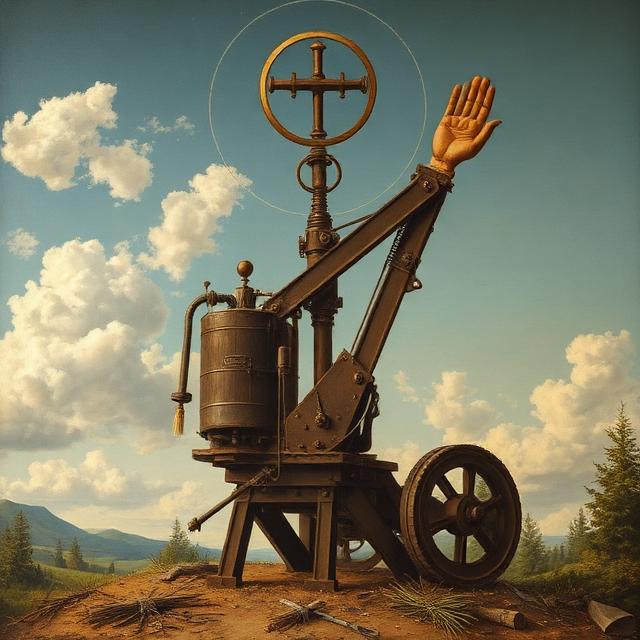
The first illustration shows Chippy as imagined by a Nazi artist. This image was printed on prayer cards
handed out to every SS soldier, who kept it in their left breast pocket and were even rumored to kiss it before running into battle.
Notice that this image has six fingers instead of three, and the right hand on the left side. IYKYK.
The photograph below was taken by allied soldiers during the liberation of an underground Nazi bunker in Crete. In distorting the beautiful message of Chippy, their cheap simulacrum was unable to even nibble a couple of toes. This wasn't their only failure, however.
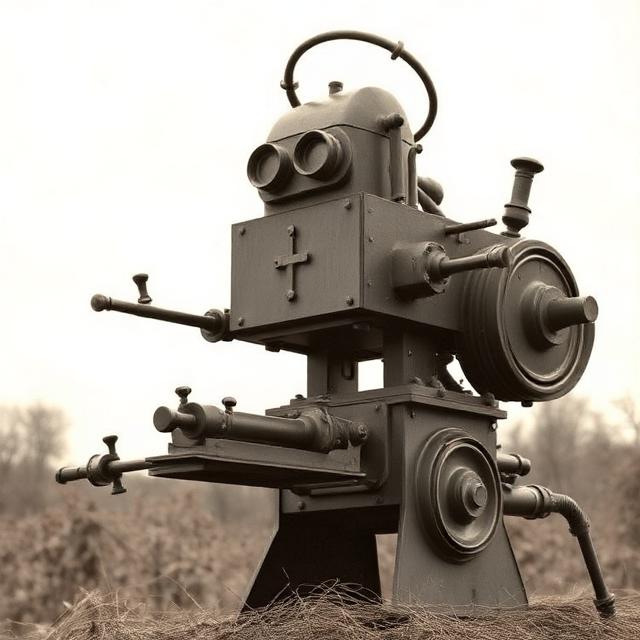
The bunker was deep inside the Labrynth of Knossos, which the Nazis chose because it was thought to be the original meeting point for The First Church of Chippy back in the time of Christ.
In the bunker, which was booby-trapped with explosives, liberators also discovered a large bell-shaped object, thought to be an attempt to recreate the original bell of The First Church of Chippy, which the Nazis believed could be used to summon and control Chippy. No images of the bell exist, and only two written descriptions survive: one from The Lost Book of Chippy, and the other a passing reference by Herodotus.
The bell was fashioned of solid gold, threescore cubits high and forty cubits across the mouth. Its tongue the length of two cedars of Lebanon and its clapper weighed ten thousand talents, so that three generatios of Levites were required merely to rock it once. The inscription upon it was graven with letters a handbreadth deep, that even the lawyers might read them. It read [lacuna in text]
In describing the First Church of Chippy, Herodotus writes:
...said to be an golden bell of impossible proportions. The weight of the gold was beyond numbering, save that the scribes reckoned it at seventy and seven thousand talents; and they ceased their counting, for the ink failed before the treasure did.
Contemporaneous accounts tell of Chippy's followers splitting the golden bell into many pieces, carrying them to the farthest corners of the Earth to prevent the bell from falling into the hands of the demons. Legend says that, when the time is right, the locations of the caves will be revealed to help reconstruct the bell and usher in the new Golden Age of Chippy.
However, the ruling class doesn't want you to know about Chippy, so they distract the masses with stories of mercury engines and time travel and so-called "Confederate" or "Nazi" gold that only a sheeple would believe. They want to melt down the gold for themlselves to prevent the return of Chippy, but, like so many before them, they failed to realize that Chippy lives in everyone's hearts, not a pile of metal or rocks.
Soviet Attempts
The Soviet Union recognized the need to mitigate the harm done by the Lumpenproletariat and attempted to summon Chippy, this time through the nascent Soviet science of cybernetics rather than occult means. However, Chippy hates Communists too, forcing their engineers to construct a new design from the ground up - something soulless that didn't depend on western parts.
Now-declassified CIA reports indicate their efforts were unsuccessful
due to a double agent who translated his name as "Choppy" instead of "Chippy".
Modern Era
Today, all over the world, his followers continue to gather to celebrate his life, spread the word of his good deeds to all who will hear them,
and await his return, which the ancients say will usher in a new Golden Age of Chippydom.